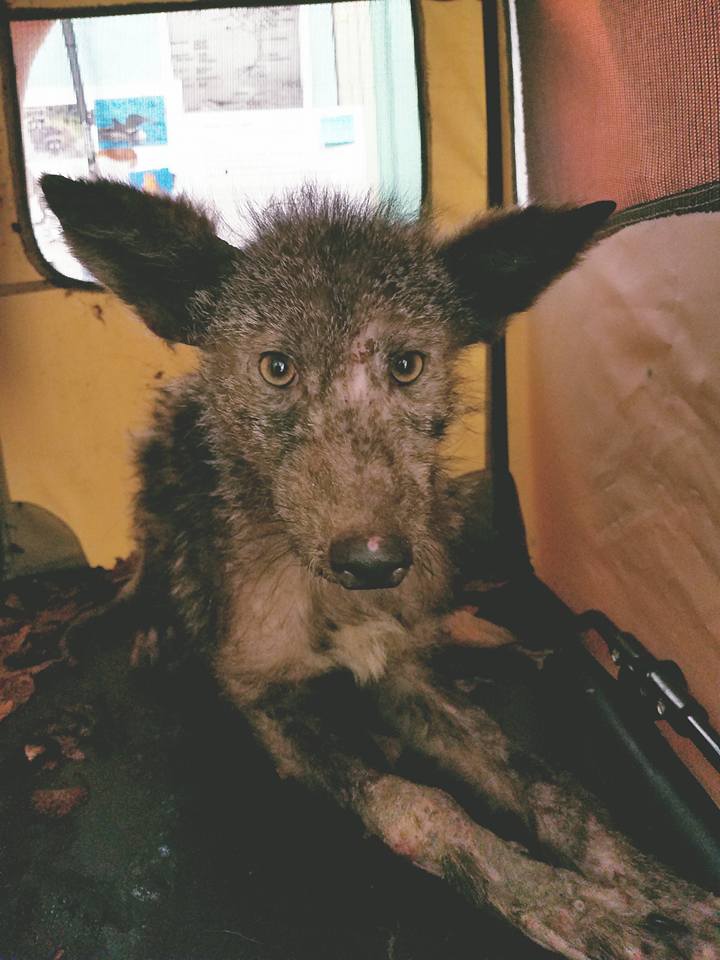
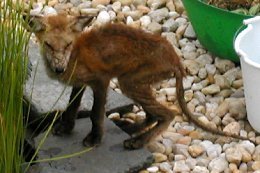
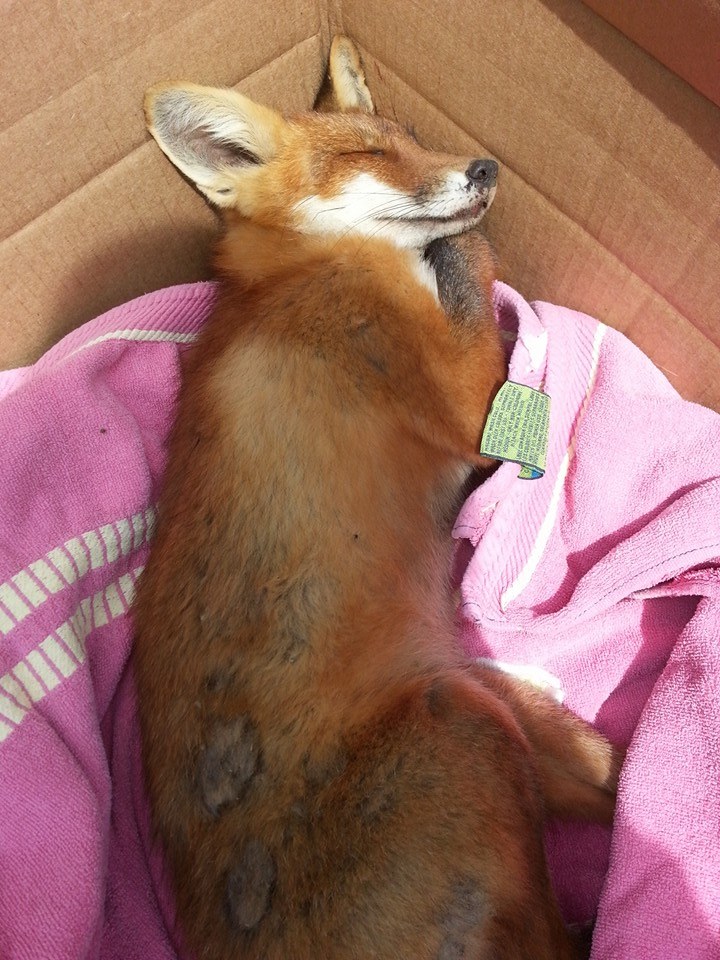
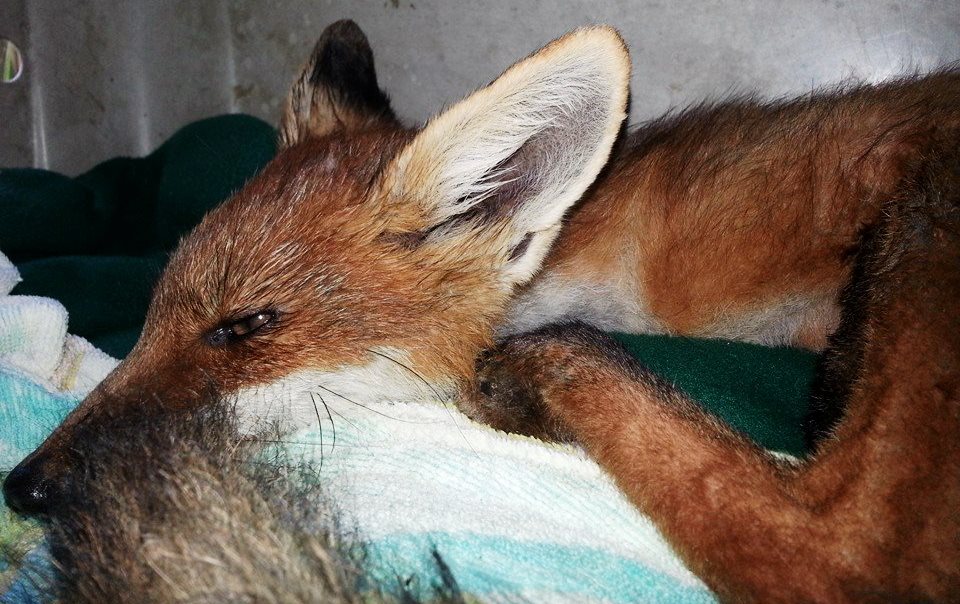
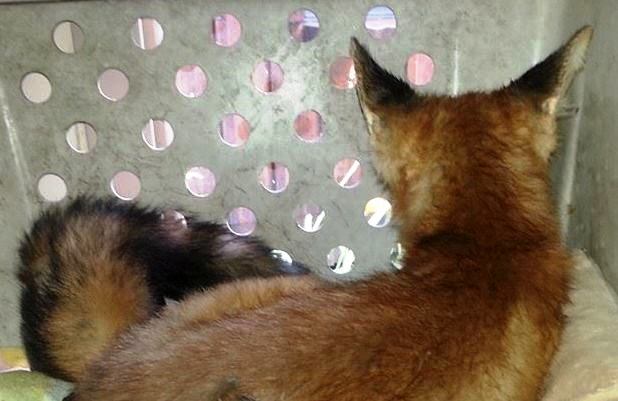
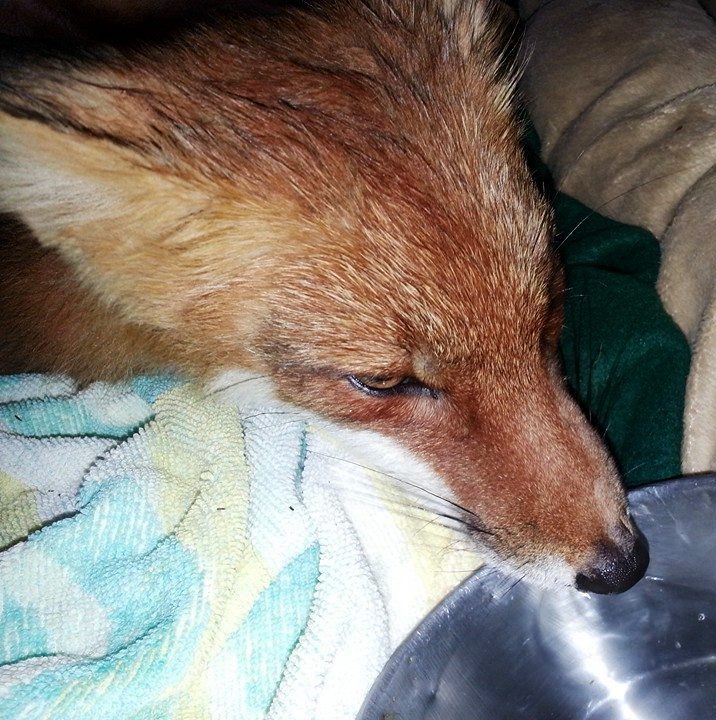
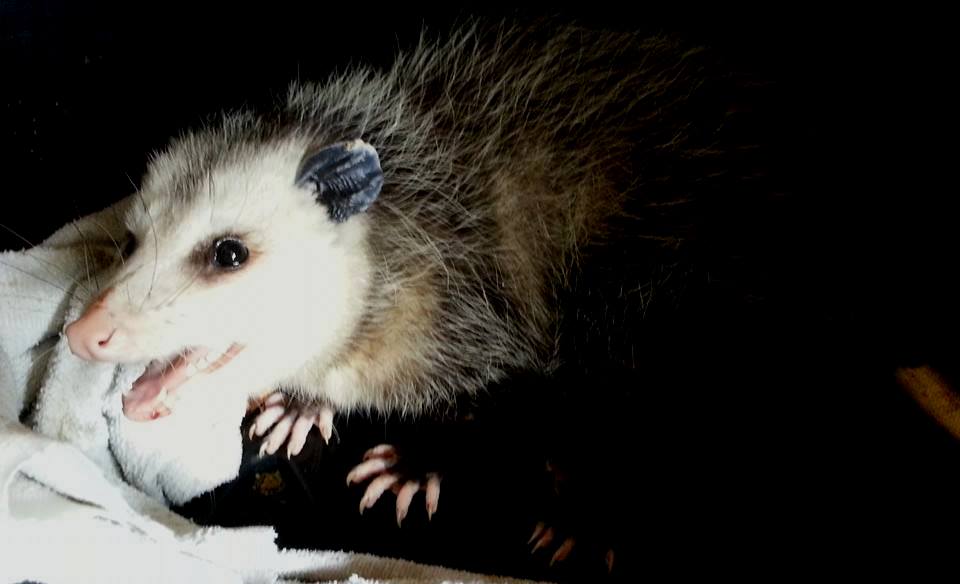
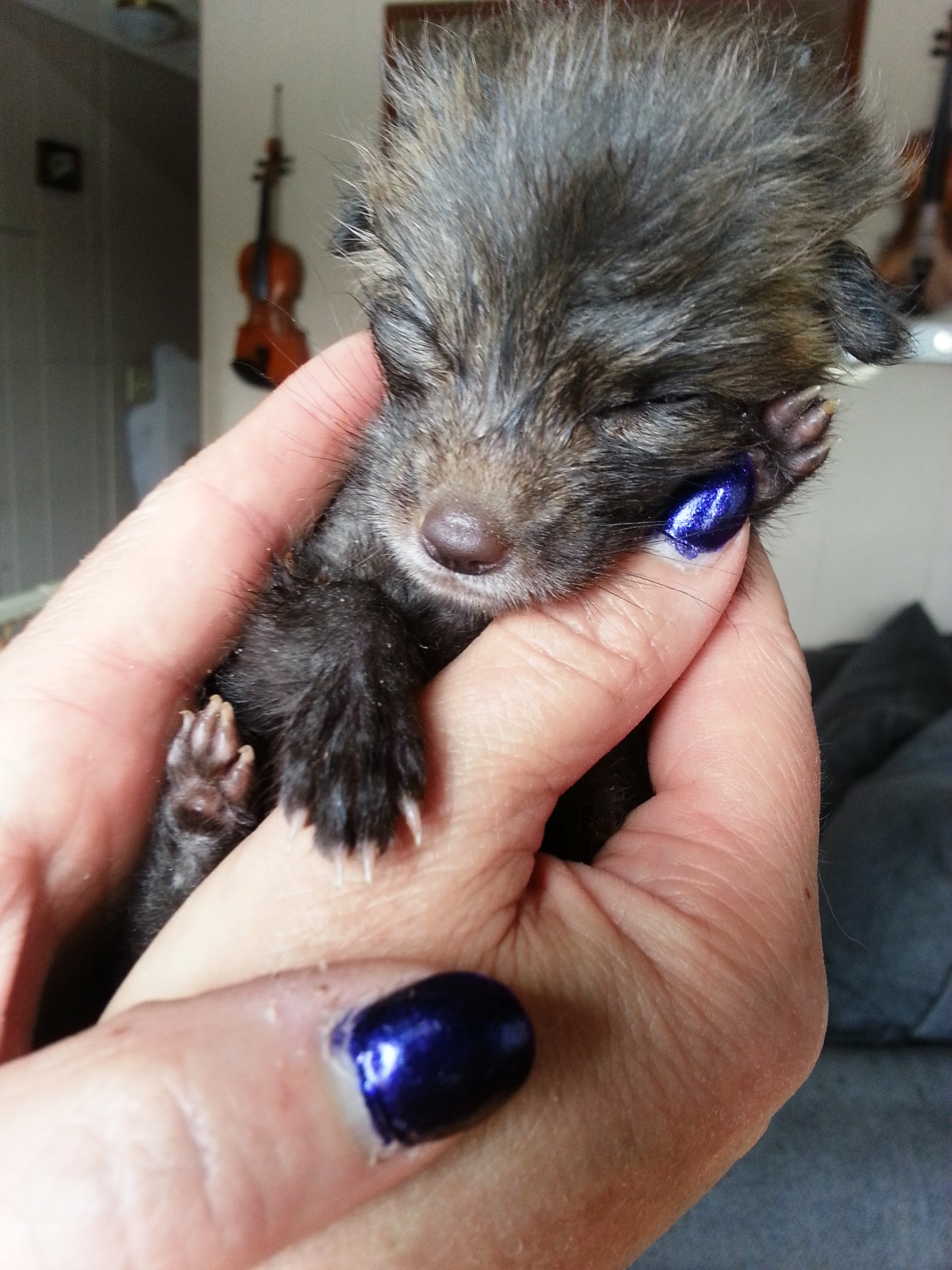
This sweetheart was found in Orchard Park, NY, dying from a nasty skin infection brought on by Sarcoptic Mange mites. She was treated for the infection with a long-acting antibiotic, given life-saving fluids and mange medicine was applied. She is presently being cared for at Fox Wood, and is a model patient – compliant and gentle. Because the Mange and infection creates a situation where they are also starving, she is being fed small amounts of easily digested food many times a day. Please check out our wishlist on Amazon.com if you would like to contribute to her care. We are also accepting donations through PayPal (foxladye@yahoo.com). We are hoping to be able to release her in Spring .
Please watch the YouTube video at the end of this article to see the treatment outlined on this page being used on a Red fox on Long Island- watch his transformation from sick back to healthy again!
I often get calls and e-mails from people who have a Red fox around that is acting lethargic or unfearful of humans. They will stay close to houses and will eat under the bird feeders, seek refuge under decks and often lay in the hay in barns. A scruffy, thin appearance usually indicates that the fox has Sarcoptic mange.
Sarcoptic mange is the name for the skin disease caused by infection with the Sarcoptes scabei mite. The mites are microscopic and can’t be seen by the naked eye. Female Sarcoptes mites burrow under the skin and leave a trail of eggs behind. This burrowing creates an inflammatory response in the skin similar to an allergic reaction. The motion of the mite in and on the skin is extremely itchy, as is the hatching of the eggs. This creates a further allergic reaction and more itching, loss of sleep and reduced immune response. Loss of fur, scaly skin and a general unthrifty appearance is characteristic of a Sarcoptic mange infestation. The condition worsens as a skin infection sets in. The foxes immune system is even more compromised and internal parasites (tape, hook and roundworms) begin to take over and absorb any nutrients that fox may find. Mangy foxes are usually starving in the late stages.
These foxes are not a threat to people, dogs, cats, etc. They are close to people and buildings because there may be easy food such as cat or dog food left out in dishes, bird seed, garbage, insects, worms, roadkill and a mouse or two. They are also losing their ability to thermoregulate and need protection from wind, shade, sun, whatever the present need of the body is. Mangy foxes (and coyotes) often seek out a pile of hay to lay in. Hay seems to relieve the itchiness and provide a source of comfort.
Sarcoptic mange is treatable if the animal is treated in time before the process of organ failure begins. The drug of choice is inexpensive and easy to obtain. Although it is an “off-label use” according to the FDA, Ivermectin injection for cattle and pigs is a very effective cure for Sarcoptic mange in foxes. This injectable solution works orally and can easily be slipped into food. The ivermectin also treats a lot of the intestinal worms and any ear mites. The catch is this: it kills the mites living on the skin but doesn’t kill the eggs. These eggs will hatch and reinfect the fox, so it has to be administered many times to kill the mange mites that hatch after treatment. A less expensive injectable version of Ivermectin such as Ivermax 1 %, Agrimectin or Noromectin 1% are all readily available online and in some farm stores. I strongly recommend treating Red foxes very aggressively, giving them the Ivermectin every five days for the first three weeks. After the first three weeks, you can dose them every ten days. Be sure to treat them for at least 4-5 weeks. A daily feeding station using dry cat or dog food can be set up to facilitate the administration of tasty treats laced with ivermectin. Frozen all beef meatballs with no spices work great and when they are warmed up, are easy to inject the medication into. A spoonful of canned cat food, a hard-boiled egg, a chunk of cooked chicken or a section of hot dog can also easily be injected with the ivermectin.
Frequently more than one fox or wild animal is coming to your yard. I recommend injecting several different pieces of food with 0.2 ml and tossing them in different directions, at least 100 feet or so apart, in the hope that one animal might find one piece, but not the other. Ivermectin is fairly safe, and if a fox happens to get more than one dose in a day, it will be fine. Meatballs work great for this! Be sure to use the meatballs with the least amount of spices (Italian style meatballs are too spicy!)
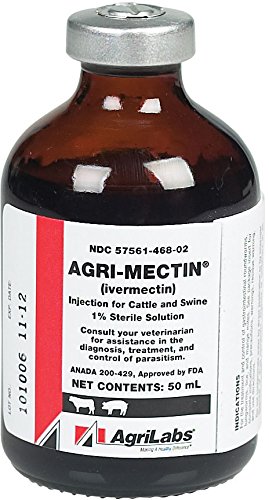
Figure your fox weighs 10 lbs, so give him 0.2 mL for each dose. Many people think they are much larger, but they aren’t. For young foxes in April or May you can cut the dose in half. You will need a large needle to draw the solution out of the bottle because the solution is rather thick. Ivermectin is a non-prescription product and available online through Amazon.com Here is a link and a picture of the products I recommend:
Agri-Mectin is a generic injectible ivermectin available on Amazon.com It comes in a 50 Ml bottle for roughly $32 it contains enough Ivermectin to treat hundreds of foxes, so it will be plenty! When you purchase the Agri-Mectin or any other bottle of Ivermectin, it comes with a rubber stopper that you will need a syringe to draw the liquid out.
Here are the best blunt needles and 1 mL syringes available on Amazon.com to use : 1mL Syringe with 18Ga 1.5″ Blunt Needle and Plastic Needle with Matching Cap (Pack of 10) . They are a 1mL Syringe , so you can easily measure 0.2 Ml, just draw the ivermectin to the “.2” near
WARNING: Use ONLY the INJECTABLE Ivermectin NOT the “POUR ON”, as the agents for carrying the pour-on through the skin are highly toxic if ingested! If anyone tells you differently, they do not know what they are doing!
WARNING! Ivermectin can be deadly to collies and mixes of collies, Make sure that Border Collies, Shelties, Australian Shepherds, smooth and rough collies and mixes of these dogs do not have access to the medication or treated food
Of course, other wildlife might get to the food before the fox does, so try to use your judgment and administer it the best way that will target only the fox. Placing a leaf or a little grass over the baited food will lower the risk of it being seen and eaten by crows. Using hard-boiled eggs will decrease the chances of the food being eaten by cats. Ivermectin is a pretty safe drug and won’t harm most wildlife. Some breeds of dogs can be very sensitive to it, particularly the collie family and Australian shepherds. Don’t use ivermectin if there is a chance a collie breed might eat the bait. Use extra caution around domestic animals. They use Ivermectin in third world countries to treat different things, such as scabies in humans. Ivermectin is also used to treat dogs for mange, and it is also a good wormer for many animals.
UPDATE: a prescription pet product called Bravecto can also be used, and only takes one single dose. Figure the dose for a ten pound dog/ fox. Give only once in a small, warm meatball or other item the fox will eat. One Bravecto will cure your fox and protect it for 3 months. For a coyote, use a piece representative of a 30 or 40 pound dog/coyote. Nexguard and Simparica , another two prescription products can also be used, again, by weight, but two doses, one month apart are best. Some people put their pets on these products for the summer, and often, a little piece to save a fox can be broken off first before administering it to your dog. Just a thought… Most vets will not prescribe e medication for a fox to you.
Bravecto Chew for a dog , a piece for a ten pound dog. Can be divided from a larger chew. For example, the 22-44 lb size can be divided into 4 pieces and treat 4 foxes! Can be purchased without a prescription outside of the USA online!!! One single dose will treat the fox, and protect it for three months. Slip the piece inside of a nice warm meatball.
Select topical products Advantage Multi and Revolution can be obtained from your veterinarian and used to help protect your domestic dogs from picking up mange in the grass surrounding your property. I have found Advantage Multi and Revolution to be very effective preventatives for mange in dogs, but very ineffective cures for mange, unless applied every two weeks during the month for at least 6 weeks. I apply Advantage Multi to all my foxes just before they are released back to the wild as a preventative measure for them.
Can people get mange? You bet, but it won’t live and reproduce on your skin. It will give you one heck of an itchy red allergic reaction if you are sensitive to mange mites though.
Please watch the beautiful short video on Youtube made by a gentleman on Long Island who was able to videotape his treatment of a Red fox with mange in his back yard. He used the treatment outlined above. Below that find a new video made by a gentleman named Jim about how he treated his fox “Mangey” as well. Thank you for taking the time to make and send us the videos!
As you many of you know, I adopt the dogs from work who are not claimed by anyone. Quite often dogs who are unclaimed have behavioral issues, and this is why they were abandoned. Twister is no exception. After being returned by two adopters because of his extreme issues, I have invested a large amount of money into professional training for Twister. Because some of his issues are related to inherited traits of the breed, it is a very complicated situation- there must be a balance between understanding his drives, and reeling them in to make them less extreme and his behavior more acceptable. Our ultimate goal is to make Twister a more adoptable, well mannered dog that can be placed in a home suitable for his breed. He needs an active farm type home with other Border Collies, and an experienced Border Collie savvy owner. I would appreciate any donations that folks could make toward Twisters continued training sessions. If you would like to donate toward Twisters rehabilitation, you can donate through paypal at foxladye@yahoo.com. Donations can also be mailed to: 11156 Old Glenwood Road, East Concord, NY 14055. be sure to specify “Twister” on your check and that donation will be applied directly to his fund
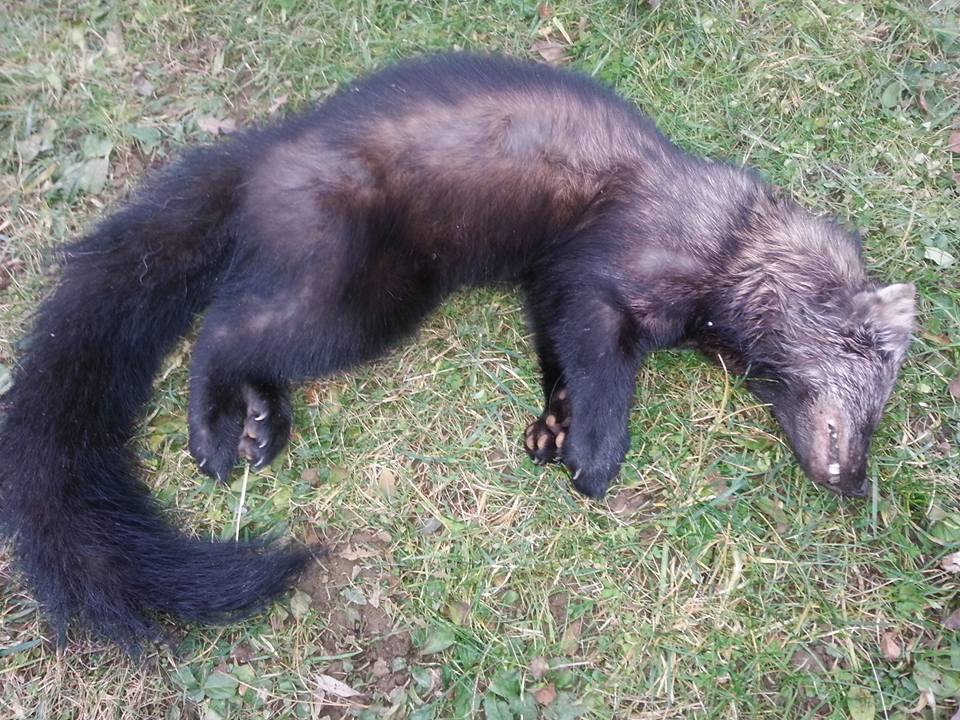
This female Fisher was very unfortunate. A tree fell on her in the woods and she was trapped for days. A man walking his dog found her, well, his dog actually found her. They called me, but were unable to find it again last night because it got dark. This morning they went out, found the Fisher and it was still alive. Unfortunately, the dog ran up and killed her before they could stop him. I have her body and am going to save her in my freezer and try to get a permit and have her mounted so I can use her for education.
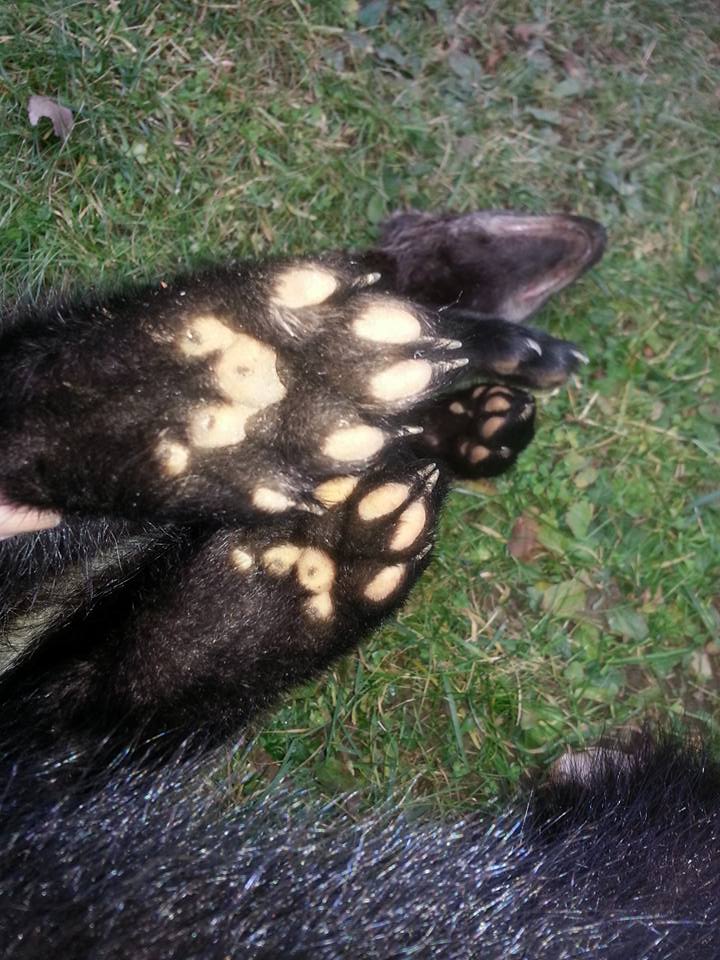
Fishers are incredible athletes! Look at her feet!
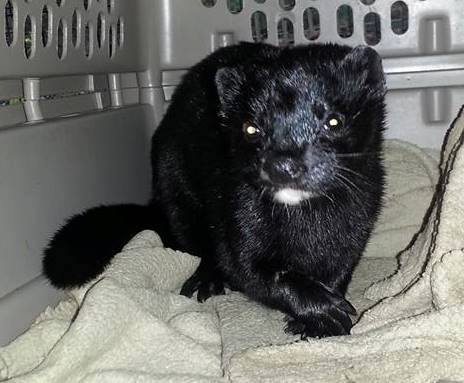
This gorgeous jet black male mink was caught in a trapper’s snare and suffered an injury to his right front leg. He was released when he fully recovered.
In August the young of the year are getting ready to leave the area where they were born and find a new territory. Unfortunately, not many of them survive. This little guy was hit by a car. A gentleman stopped when he saw the pup laying in the road, and intended to move him off of the road, thinking he was deceased. Imagine his surprise when he grabbed the foxes rear legs and lifted him up to set him in the grass on the side of the road- and the fox moved its front legs! Immediately he wrapped the fox in a towel and placed it in a box and began making phone calls to look for help for the fox.
Once Fox Wood Was contacted, we quickly made arrangements to meet. The fox was then immediately rushed to a wonderful veterinarian who we work with. He was carefully examined, X-Rayed, and found to have head trauma, but no broken bones! Fluids and a steroid were given, and a long acting antibiotic was given. There was not much else to do but wait and pray.
Day One, the fox remained unconscious.
Day 2: Semi- conscious, Gave some more steroid to reduce brain swelling, and an hour later taking some nourishment. (See video on YouTube.)
Day 3: Laying in a much better position with head up! Eating and drinking with help
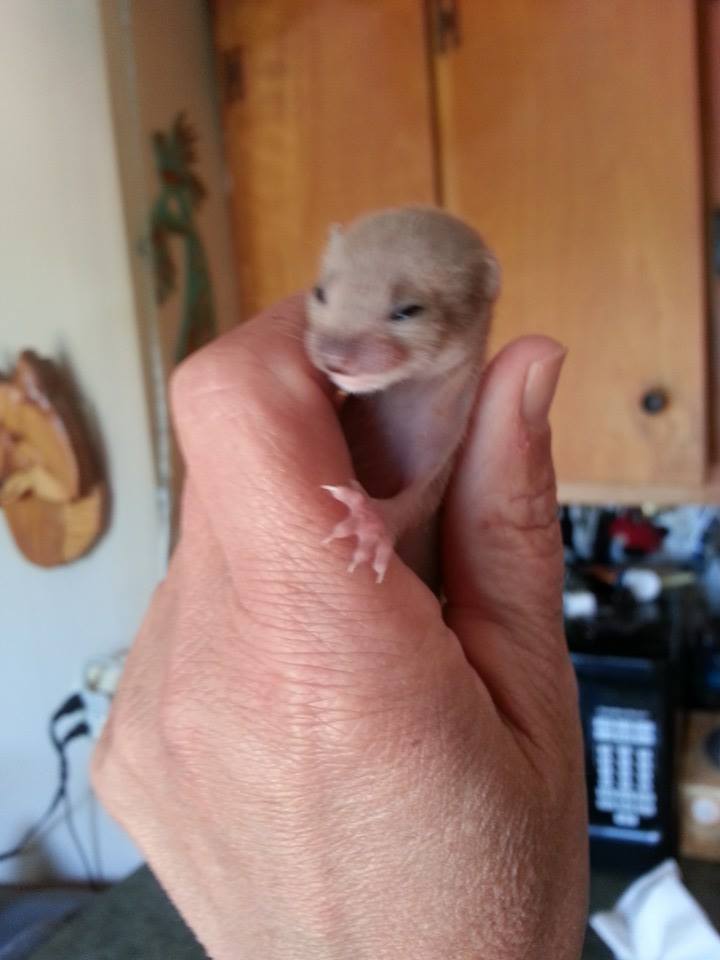
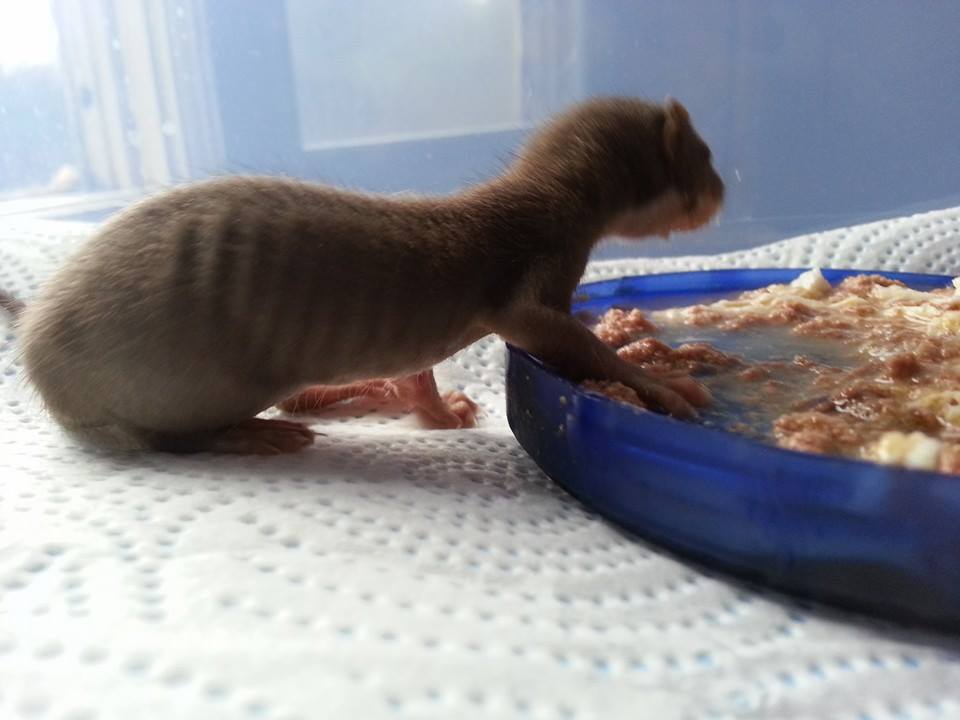
The weasel was released over the weekend. I’m sorry I don’t have pics of the release for you, but she was VERY wild and very elusive and I must respect that.
She entered life in the wild via a process called “Slow Release” where she is given the opportunity to familiarize herself with the surroundings in the safety of her cage, and then the door is opened and she is allowed the freedom to come and go as she pleases. Food, water and a familiar shelter for her were provided for her to come back to as needed. I won’t reveal the location, but it is excellent weasel habitat, loaded with mice.
Above are a couple photos of her being raised. As she became a young adult, her natural instincts began to reveal themselves and she did not want to be handled and began to become more secretive in her movements. Though followers would have loved to see her all grown up, my responsibility to her is greater, so that is why there were no more photos of her. I appreciate your understanding this.
One of the things that you will find we do NOT do here at Fox Wood is exploit our wildlife. We don’t get the donations that result from the exploitation of displaying animals in uncomfortable public settings or putting them on public display here at our facility. What we do here is strictly for the animals, not for the money, not for our ego’s. That is what sets Fox Wood apart. We rely only on donations from people who understand what we do and why we do it.
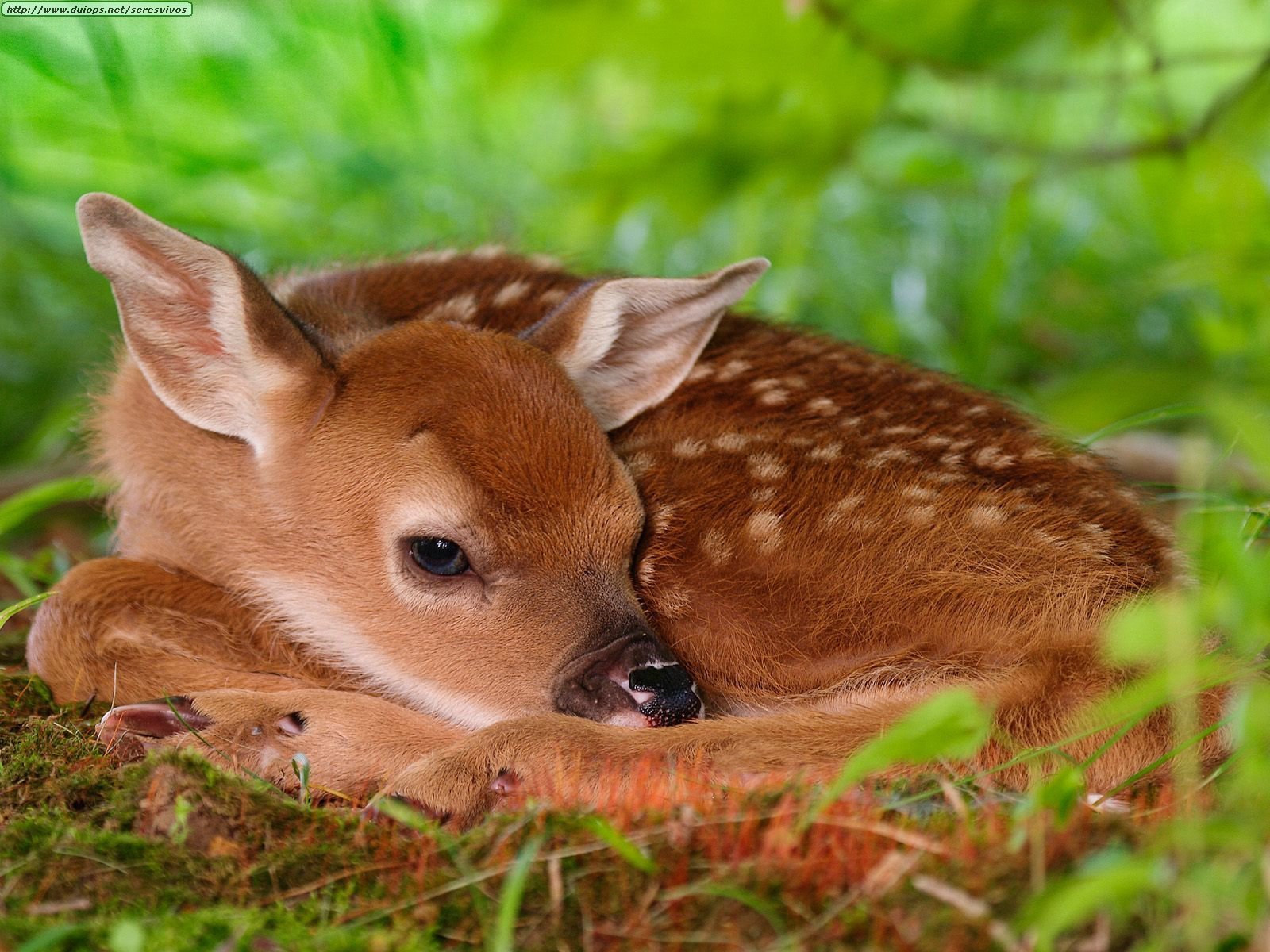
In May and June Fox Wood receives many calls from well meaning people who are worried about an “abandoned fawn”. It is important to know that fawns are born with a natural defense mechanism. When fawns are first born they have no appealing scent to predators and they have an amazing ability to lay perfectly still and quiet, allowing the fawn to hide in plain sight. The mother deer does not stay with her fawn because she does not want to alert predators to her baby’s location. She comes back to her fawn throughout the day and night, but only when it appears there are no humans or other predators around. She feeds and thoroughly cleans the fawn to erase any scent they may have. Instinctively the fawn knows that when mom leaves, it must lay very still and silent in the location mom left it. Since the fawn does not move and no mother is present, people often think it is abandoned. Because of this, healthy fawns are often “kidnapped”.
A doe may keep her babies in the short grass area, near your home, in your garden, etc. for the first 3 days, not in the woods where the predators are hunting. These first days a fawn can’t outrun a predator, so they go limp when someone picks them up. They are not dying, they are playing “possum” so you will not be interested and put them down. With twins, a doe will leave one baby in one place, and then 300-500 feet away, she will leave the other. She then goes off to the closest hiding area and forms a triangle so she can watch over both, unseen, until it is time to feed again. She will not let them travel with her until they are old enough to keep up with the herd, but she is never far away.
There are times when a fawn will not express normal fawn behavior. We will usually be concerned when we get a call about a fawn that is wandering around crying out. This is not natural behavior as it attracts predators. Diarrhea, flies, falling down, limping, twins together and obvious wounds are all signs of a fawn that needs help. If you suspect a fawn needs help, or just want to make sure a fawn is OK, you can contact us or your local Conservation Office for direction. In closing, remember the fawn that is lying still in your yard or garden is just nature’s way of giving us one more reason to smile. The fawn will leave on its own in just a couple of days, so take a picture and leave the baby for its real mother
This opossum was found on the side of the road in a snowbank, too weak to move because she was starving. I gathered her in a towel and brought her home. For the first couple days it was touch and go, and I was only able to feed her small amounts of chicken noodle soup. She started regaining some strength, and soon started eating on her own. She will be released as soon as the weather breaks and there is plenty food around for her.
The first Red fox pup of 2015 is here! He is almost three weeks old and was brought to Fox Wood by someone who at first thought they were raising a domestic puppy. He wasn’t fed the right foods from the start, so we are trying to get him back on track. When he is old enough, he will get to join some of our wonderful foxes who love to raise the babies.